Summary Highlight:
Many hiring teams verify a degree only after the candidate has joined, and then they wait. This blog follows an HR head in Pune through one such week, when eleven education checks were still open on joining day. Her story explains how online degree verification works in India, why timing matters so much for employers, and how digital signatures make a degree certificate tamper-proof. It also covers what to look for in a verification service and what shapes the cost.
Table of Contents
Introduction
Thirty graduate trainees were joining on Monday, and on Friday evening Meghna’s background verification tracker still showed amber against eleven names.
Address checks had cleared, and so had previous employers. The degrees were the problem. Her team had written to each university more than two weeks earlier, and most of those emails were still waiting in examination offices she would never see.
One file looked different. Ishaan, a civil engineering graduate, had sent a degree certificate that his university had already verified and that carried a digital certification. Her team opened it, confirmed that nothing had changed since it was certified, and closed the check in under a minute.
That evening, Meghna asked a fair question. If one candidate could arrive with a verified degree, why was her team still chasing the other eleven by email? This blog answers that question and, along the way, explains how online degree verification actually works for employers in India.
What Online Degree Verification Means
What does it actually mean to verify a degree online? At its simplest, someone confirms with the issuing institution that a degree is genuine, without paper changing hands or anyone visiting the campus.
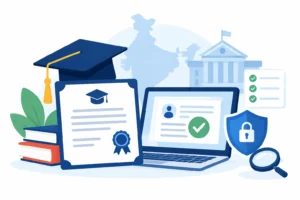
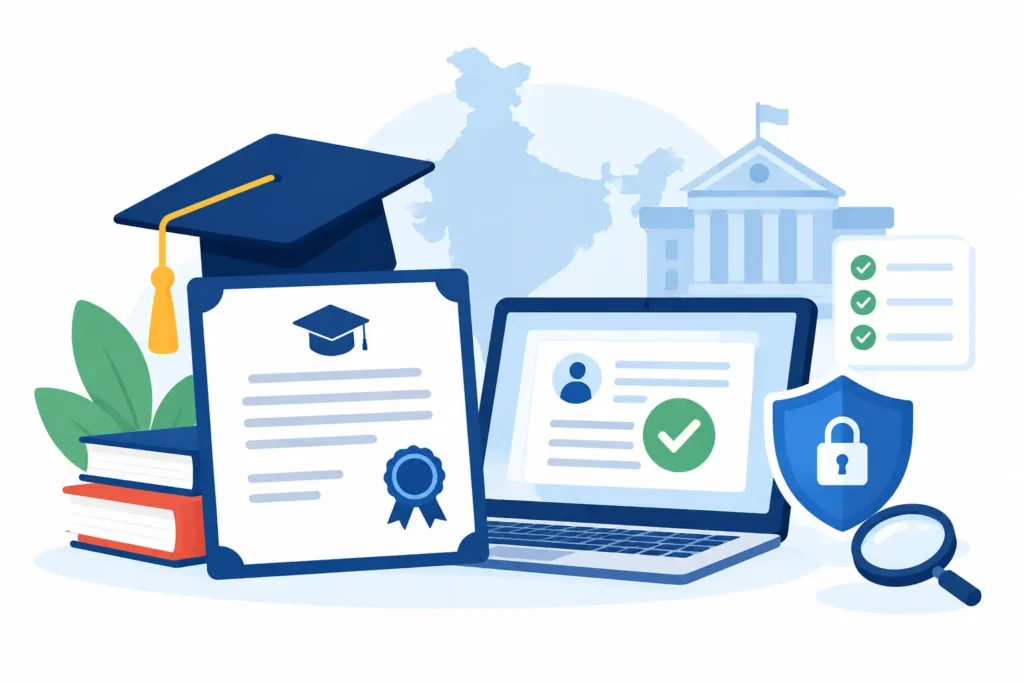
The check happens at the source: Truecopy verifies a document with the institution that issued it rather than judging a copy by how it looks. That difference separates university degree verification from simply studying a scan.
The result comes back digital: After verification, Truecopy digitally certifies the document, which makes it tamper-proof, and emails it to the applicant.
It reaches beyond the degree: The same online certificate verification services also cover transcripts and supporting documents, which is why the wider term is academic credential verification. Truecopy also obtains official verification reports from Indian institutions, since many professional bodies ask for authentic educational certificate verification.
Example: At first glance, Ishaan’s certificate looked like any other PDF. The difference was that his university had already confirmed it, and the certification showed nobody had touched it since. For Meghna’s team, that was digital degree verification in its plainest form.
Why Degree Verification Matters for Employers
Why should a hiring team care about when a degree gets checked? Because the later the check happens, the harder it becomes to act on what it finds.
Checking after joining is slow. Truecopy’s degree verification page notes that when companies verify credentials after onboarding, the process “takes time (3-4 weeks)” and costs a significant amount of money.
Pre-verified candidates stand out. The same page says pre-verified credentials give a candidate “a definite edge over other applicants.” For recruiters, that edge means one less open item on the tracker.
Degree verification for employers is therefore as much about timing as it is about trust. Employee education background verification that finishes before joining day leaves far fewer loose ends.
Example: The last two university replies reached Meghna three weeks after Monday. Both degrees were genuine. By then, however, both trainees had finished induction and started on live projects. Had either reply gone the other way, her team would have been reversing an onboarding instead of simply holding back an offer.
How the University Certificate Verification Process in India Works
So how does a verification request actually move? The traditional university certificate verification process in India depends on the receiver contacting the issuer, usually by email or letter, and then waiting. Truecopy calls contacting the issuer the right way to verify, though not the only way.
For a candidate, the process to verify degree online through Electronic Transcripts by Truecopy takes six steps:
• Submit an inquiry through the contact form.
• Receive the timeline and charges for the case.
• Place the order.
• Truecopy verifies the document with the issuing institution and digitally certifies it.
• The certified document arrives by email.
• The candidate uploads it to DigiLocker or emails it to employers.
The route changes slightly when a verification agency is involved. In that case, the agency submits the student’s details through Truecopy’s form, and Truecopy verifies the documents only after the student gives consent.
Example: Ishaan, it turned out, had completed all six steps a month after his convocation. He had uploaded the certified degree to DigiLocker and simply shared it with every employer after that.
Moving Verification Before the Offer
What if the check happened before the offer letter instead of after joining? Truecopy’s degree verification service suits that order of events, because the candidate verifies once and then shares the result wherever it’s needed.
Verify once, share many times: A certified degree can sit in DigiLocker or go to employers by email. For students heading abroad, Truecopy delivers it to an overseas university on the same day the order is placed.
Marksheets can travel with the degree: Truecopy verifies transcripts and supporting documents with the issuing university as well, so graduation marksheet verification doesn’t need to become a separate chase.
Electronic transcripts follow the same path: Verified electronic transcripts go straight to whichever destination the candidate names, and Truecopy confirms that an employer can be one of them.
Example: Before the next hiring season, Meghna changed one line in her offer checklist. Candidates who already held a verified degree could share it at the offer stage, while everyone else would go through her agency’s usual consent-based check.
How Digital Signatures Protect a Degree
Why should an employer trust a PDF that never came from the university’s own inbox? The answer lies in how the document gets signed.
Universities can sign at the point of issue: Through TRUESigner Credentials, universities issue official transcripts, certificates and verification reports electronically. Truecopy describes AATL-based digital signatures as what makes such a transcript tamper-proof.
Anyone opening the file can check the signer: The reader can verify the signer’s identity online at the moment they open the document.
The issuer doesn’t need chasing again: As Truecopy explains, a digitally signed degree lets the receiver identify and authenticate the signer. Receivers therefore no longer need to re-verify with the university, and online degree certificate verification becomes a check rather than a wait.
Example: When Meghna’s team opened Ishaan’s file, the certification told them who had certified it and confirmed that nothing had changed since. Nobody had to write to his university at all.
Degree Verification at Scale for HR Teams
What happens when the batch is three hundred rather than thirty? At that size, online degree verification for HR teams has to work in volume, not one email at a time.
Agency requests with consent: Background verification agencies can submit candidate details through Truecopy’s verification form, and verification proceeds only once the student consents.
Direct delivery into systems: For receivers, Truecopy offers API integration that brings transcripts directly into their own systems.
Coverage beyond India: Truecopy says it covers verification for more than 60 countries, which helps when a hiring pool includes graduates from abroad.
When you compare bulk degree verification services for companies, it helps to ask three things. Can requests go in as a batch? Is consent recorded? Can results arrive directly in your HR or background verification system? Degree verification for recruitment and hiring runs most smoothly when the answer to all three is yes. Academic verification solutions for enterprises should also state clearly which institutions and countries they cover.
Example: Meghna’s company hires in two waves each year. For the larger wave, she asked her verification agency to route education checks through a source-verified channel with candidate consent built in.
What to Look for in a Degree Verification Service
How do you tell a dependable verification service from a slow one? On a search results page, online degree verification services in India can look much alike. The differences appear once you ask the right questions, and when you compare degree verification service providers in India, five of them do most of the work:
• Source verification: Does the service confirm the degree with the issuing institution?
• Tamper-proof output: Is the result digitally certified so that any later change shows up?
• Consent and security: Does it ask for the candidate’s consent and protect data with encryption and recognised security standards?
• Coverage: Which universities and countries does its university degree verification reach?
• Clear timelines and charges: Does it share both before you place an order?
The best degree verification services in India should be able to answer all five without hesitation. Cost, meanwhile, depends on a few factors rather than one figure. We says its total charges depend partly on the issuing institution’s fees, which vary between universities. On top of those come a one-time fee for procuring or verifying and a small fee per destination. It also shares timelines and charges after the inquiry, with “no hidden charges.” So, among the degree verification services India has to offer, your hiring volume and destinations will shape the right plan.
Example: Meghna turned these five questions into a one-page checklist for her procurement team, who now use it whenever they review a verification partner.
Electronic Transcripts by Truecopy
Who runs the service behind Ishaan’s certificate? Electronic Transcripts is a service of Truecopy Credentials Pvt. Ltd., an ISO 27001:2022 certified company, an authorised partner of DigiLocker (Government of India) and a member of TAICEP.
Its services include electronic transcripts, procurement of transcripts, and degree verification. It sends to more than 3,000 destination universities, and it lists evaluation agencies, immigration, and employers among its receivers. It also uses advanced encryption to handle academic documents safely. For anyone who needs to verify university degree records from afar, source checks and digital certification are the core of what it offers.
FAQ
They confirm a degree with the institution that issued it, without anyone visiting the university or exchanging paper. With Truecopy, the verified degree comes back digitally certified and tamper-proof, so an employer, university, or agency can rely on it.
Submit the inquiry form on the Electronic Transcripts site, and you’ll receive the timeline and charges. Once you place the order, Truecopy verifies the degree with the issuing institution, digitally certifies it, and emails it to you. You can then upload it to DigiLocker or send it to an employer.
The right choice depends on your needs. However, a strong service verifies at the source, returns tamper-proof digital documents, asks for consent, protects data and shares timelines and charges upfront. Truecopy’s Electronic Transcripts cover these points and offers verification for more than 60 countries.
Yes. A candidate can get a degree verified and certified through Truecopy, then email it to the employer or share it through DigiLocker. Truecopy can also send documents directly to an employer, and verification agencies can request cheques, which Truecopy carries out only after the student consents.
It depends mainly on how quickly the issuing institution responds, so Truecopy shares the timeline after your inquiry. For comparison, Truecopy notes that companies verifying credentials after onboarding often wait three to four weeks.
Yes. Truecopy verifies degree certificates with the issuing institution and digitally certifies them, which makes them tamper-proof. Universities that sign credentials with AATL-based digital signatures go a step further, since anyone opening the file can verify the signer online.
Truecopy confirms the exact list after your inquiry, because it depends on the issuing institution. Its guides note that transcript applications usually need copies of the degree certificate and marksheets, plus photo ID proof. It doesn’t accept original documents or self-attested copies, and agency requests also need the student’s consent.
It confirms that a candidate’s qualification really came from the institution named on it, ideally before that person joins. Checking earlier also avoids the three-to-four-week wait and the cost that Truecopy is associated with verifying credentials after onboarding.
With Truecopy, yes. It verifies documents at the source, digitally certifies them so they’re tamper-proof and uses advanced encryption for academic documents. Truecopy Credentials is also ISO 27001:2022 certified, and it verifies documents for agencies only after the student consents.
Partly, yes. Truecopy offers API integration so receivers can take transcripts directly into their own systems, and verification agencies can submit requests through a dedicated form. For a specific HR or background verification setup, Truecopy’s team can confirm what fits.
Its Electronic Transcripts service verifies degrees, transcripts and supporting documents with the issuing institution, then delivers them electronically to universities, evaluation agencies and employers. Meanwhile, its TRUESigner Credentials platform lets universities issue digitally signed credentials and verification reports.
Conclusion
The following July, a new batch of trainees joined Meghna’s company. This time, the tracker turned green well before joining day. About a third of the degrees had arrived already verified, just as Ishaan’s had a year earlier.
Nothing about the trainees had changed. What changed was the order of events. Online degree verification works best when the check happens at the source and before the offer. That way, a hiring team reads a certified result instead of waiting on an unanswered email. For candidates and employers who want that order, Electronic Transcripts by Truecopy offers source-verified, digitally certified degrees that anyone can rely on.